I've used my torch to take all these pictures, they're every little scenes showed in my whole film opening, I love they way it helps attracts people more focus on them.
Se7en came out in 1995 and I absolutely loved it, literally from the first second of the opening credits. I watched it again during the weekend. The opening credits are a grunge-design fan’s dream. The music is amazing; the images and the texts are dark, dirty, scruffy, scary and perfectly convey the idea. The typography is edgey and the background colours are black, browns and reds - really sets the tone.
Start from 9:45 and finish at 10.40 of the film clip of The Child's Eye. There's a woman standing behind the girl who is sleeping and as you can see the lighting effect they've used is quite dark, so I decided to use the similar effect as the film. There are more close up shots in the film, which shows how her emotion as it changes. And there is an extreme close up shot of her eyes, which shows that she felt someone is behind her. There's a figure in the background, however it lacks identity and this therefore creates the illusion of mystery. However in my film, although I have taken this idea I decided that it went on for too long; this clip build up suspence but I wanted mine to have a sudden shock. To create this effect I decided to make the amount of time of this sort of clip shorter because it wasn't the main focus in my opening sequence, and this clip isn't the opening and thats why there is more time spent here to create the eerie atmostphere.
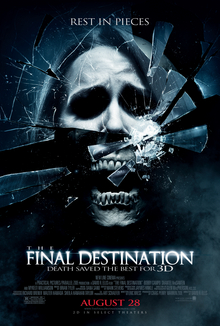
The Final Destination (also known as Final Destination 4) is a 2009 3Dsupernatural-horrorfilm written by Eric Bress and directed by David R. Ellis, both of whom also worked on Final Destination 2. Released on August 28, 2009, it is the fourth installment to the Final Destinationfilm series, and the first of which to be shot in HD3D.
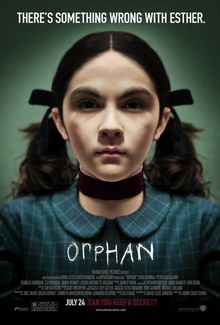
Orphan is a 2009 American horror and thrillerfilm directed by Jaume Collet-Serra, starringVera Farmiga, Peter Sarsgaard, and Isabelle Fuhrman in the title role. The film centers on a couple who, after the death of their unborn child, adopt a mysterious 9-year old girl. Orphanwas produced by Joel Silver and Susan Downey of Dark Castle Entertainment andLeonardo DiCaprio and Jennifer Davisson Killoran of Appian Way Productions.The film was released theatrically in the United States on July 24, 2009.The film received mixed critical reviews but Fuhrman's performance as Esther was acclaimed.
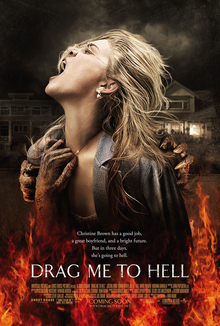
Drag Me to Hell is a 2009 American horror film, directed by Sam Raimi, with a screenplay by Sam Raimi and Ivan Raimi. The plot revolves around loan officer Christine Brown (Alison Lohman), who tries to impress her boss by refusing to extend a loan to a gypsy woman by the name of Mrs. Ganush (Lorna Raver). In retaliation, Ganush places a curse on Christine which, after three days of escalating torment, will plunge her into the depths of Hell to burn for eternity.
Raimi and his brother Ivan wrote Drag Me to Hell before Sam had worked on the Spider-Manfilms. The film premiered at the Cannes Film Festival and was released to wide critical acclaim. It was also a box office success, making $90.8 million worldwide, against a $30 million budget. (This information has been taken from Wikipedia)
Both films are based on Kôji Suzuki's novelRing and focus on a mysterious cursed videotape which contains a seemingly random series of disturbing images. After watching the tape, the viewer receives a phone call in which a girl's voice announces that the viewer will die in seven days. The film was a critical and commercial success. (This information has been taken from Wikipedia)
Death Bell (Hangul: 고死: 피의 중간고사; RR:Gosa: Piui Junggangosa) is a 2008 South Korean film. The only Korean horror film released over the summer of 2008, it is the firstfeature by former music video director Chang (real name Yoon Hong-seung), who also co-wrote the screenplay. Death Bell stars Lee Beom-soo in his first horror film role, and K-popsinger Nam Gyu-ri in her acting debut. Set in aKorean high school, the film's native title refers to gosa, the important midterm exams that all students are required to sit.
The Child's Eye (Chinese:童眼) is a 2010 Hong Kong horror film by the Pang brothers. The film takes place in 2008 in Bangkok where six find themselves at the Chung Tai Hotel. After Rainie (Rainie Yang) sees a female ghost and Ling (Elanne Kwong) finds a disembodied hand, they find that while at dinner, the three men they came with have disappeared. Rainie leads the girls to find their friends.
The Child's Eye premiered on September 4 2010 at the Venice Film Festival, making it the first 3D Hong Kong horror film. The film has received negative reviews noting the films script quality. (This information has been taken from Wikipedia)
One of the main idea for my film opening is this part of The Child's Eye, the frighten background music, the gloomy light and the amazing act of the actress, the expression in her eyes seriously is the focal point which attracts audiences' attentions. I like the way that the ghost hide at her back and wake up without any sounds but it scared me.
This is my first experience of filming; it took us a double media lessons to finish those four different clips of our films. This film is an assignment which Mr Breese gave us few days ago; it is to film a simple shot of someone walking through a door, and sitting down in front of a desk and talking to someone. We are in a group of four people, Dasha, Kim, Charlotte and I.
We were given two cameras and two tripods for this scene. Mr Breese has taught us how the camera works well with good control of camera angles and effects of some specific shots. And prevention of the risks about placing the camera on the top of the tripods, and do not carry the camera on the top of the tripod while we were walking. We've been walked around for 3 minutes to find the best placing for filming. Finally, we decided to film it in a house area, walking towards a door, push to open the door, walking towards another character, and then sitting down on the chair, having a disgussion with each others. Moreover, I was quite stressed about it, as this is my first experience of filming, I got some good tips of the previous scenes which they filmed before me.
The camera is placed outside the house area, someone in our team has filmed Charlotte walking through the door. There was another camera rolling across the room, in order to get the shot of her walking toward me, while I was sitting on the chair. Once she sat down, Dasha and Kim cuted the scene, and placed the two cameras one to my left side and the other one on Charlotte's left side. That both of us can't see the camera on each others' side while recording it. Both of them filmed our short conversation. This will then be edited to convey a reverse shot.
Shot reverse shot is a film technique where one character is shown looking at another character (often off-screen), and then the other character is shown looking back at the first character. Since the characters are shown facing in opposite directions, the viewer assumes that they are looking at each other. While taking this into account, we were also been told of the awareness from our teacher. Do not break the 180 degree rule. The 180 degree rule is when the camera cannot pass 180 degrees from where it is filming. You have to almost imagine a straight line. If you cross that line, you have broken the 180 degree rule.
After filming, we went back to the class, and extracted the SD Cards from both cameras, and inserted them into the computer. We used a video editing program which is called "Corel Video Studio". I had alot fun with the editing of our film, we use some special effects, like "painting creator", it can be record every steps of my drawing, I really enjoyed it.
This is the final version clip of my preliminary task, I editted it by using the "Corel VideoStudio", and I'm more concentrated on shot reverse shot andmatch on actions.
The 180° rule is a basic guideline in film making that states that two characters (or other elements) in the same scene should always have the same left/right relationship to each other. If the camera passes over the imaginary axis connecting the two subjects, it is called crossing the line. The new shot, from the opposite side, is known as a reverse angle.
(This definition has been taken from Wikipedia)
This is a youtube video with detail explaination how does the 180 degree work. A good example of two people stand facing each other and talking, the camera should only be placing at one side of the action. We should not break the rule, as it will become both charactors will face the same side, this will make our audiences confused.
Examples
In the example of a dialogue between two actors, if Owen (orange shirt in the diagram) is on the left and Bob (blue shirt ) is on the right, then Owen should be facing right at all times, even when Bob is off the edge of the frame, and Bob should always be facing left. Shifting to the other side of the characters on a cut, so that Bob is now on the left side and Owen is on the right, will disorient the viewer, and break the flow of the scene.
In the example of an action scene, such as a car chase, if a vehicle leaves the right side of the frame in one shot, it should enter from the left side of the frame in the next shot. Leaving from the right and entering from the right will create a similar sense of disorientation as in the dialogue example.
An example of sustained use of the 180 degree rule occurs throughout much of The Big Parade, a 1925 drama about World War I directed by King Vidor. In the sequences leading up to the battle scenes, the American forces (arriving from the west) are always shown marching from left to right across the screen, while the German troops (arriving from the east) are always shown marching from right to left. After the battle scenes, when the weary troops are staggering homeward, the Americans are always shown crossing the screen from right to left (moving west) and the Germans from left to right (moving east). The audience's viewpoint is therefore always from a consistent position, in this case southward of the action.
Problems caused and solutions
The 180 degree rule enables the audience to visually connect with unseen movement happening around and behind the immediate subject and is important in the narration of battle scenes. The visual disjointedness of the battle scene on Geonosis in the Star Wars film Attack of the Clones is an example. Avoiding crossing the line is a problem that those learning filmcraft will need to struggle with. In the above example with the car chase, a possible solution is to begin the second cut with the car driving into frame from the "wrong" side. Although this may be wrong in the geographic sense on set, it looks more natural to the viewer. Another possibility is to insert a "buffer shot" of the subject head-on (or from behind) to help the viewer understand the camera movement. (This information has been taken from Wikipedia)